
A few songs that would have played during the internment camps, was influential music for the musicians or were internment camp bands.
Glenn Miller- In the Mood
Sidney Bechet- Summertime
Bix Beiderbecke- Singin the Blues
Benny Goodman- Sing Sing Sing
Wednesday, December 2, 2009

Japanese American Internment Camp Movies
Come see the Paradise (1990)
Snow Falling on Cedars
Farewell to Manzanar (1976)
Executive Order 9066
Collaboration: Edwina "Edi" Dai, Jerry Knaack
True Unsung Heroes

Imagine this. You're about 20 years old living in a country where living conditions could be, well...better. There's a country. A glorious country. The land of opportunity. This land of opportunity, however, is fighting a war, and they need help. They promise that in exchange for your help, you can finally get a ticket to this glorious land...and money to establish yourself there! So once you have done what they ask of you, they suddenly tell you, "Thanks, here's the ticket, but we can't give you everything else we promised you."
That ticket is called citizenship.
In 1941, President Roosevelt drafted 160,000 soldiers from the Philippines to fight in the war that succeeded the bombings in the Philippines and Pearl Harbor. The US promised full benefits and US citizenship to any Filipino soldier
 who volunteered to fight. Motivated by anger and incentives given by the US, over 250,000 Filipinos answered the call to fight alongside American soldiers against the Japanese in World War II. That number does not even include the number of guerrilla fighters who helped the United States as well. In 1942, Congress passed legislation that would give the soldiers US citizenship. Seems like they were holding their end of the bargain so far. However, following the end of the war in 1945, President Roosevelt signed the Rescission Act of 1946, one that would take away that promise giving full benefits to all nations fighting alongside the US, except the Filipinos. It wasn't until 1990 when President Bush signed a law that allowed them to come to the US but without veterans benefits.
After waiting more than 40 years for benefits, coming to the United States was no longer much of a reward. Many were growing old and could barely work. After moving to the US, the Filipino veterans were forced to move into transitional veteran housing, usually packed and overcrowded. Any money they received most likely went to their families left in the Philippines and the veterans would just remain there without benefits and without justice. Even today, the veterans struggle to find work so they can have a sustainable amount of income. But in this economy, the veterans are hit hard. They cannot find work so many must make do with what they have. California's state budget cuts have reduced their income benefits.
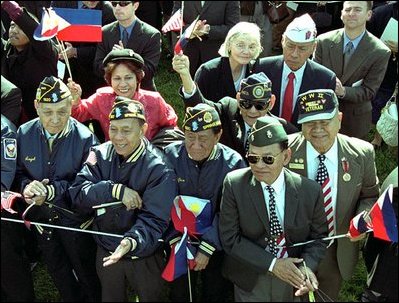
Many people, however, do not completely agree with the veterans' campaign for justice. One article on CNN.com is entitled, "U.S. to pay 'forgotten' Filipino World War II Veterans" The word "forgotten" stands out because it is in parentheses insinuating that Filipino veterans weren't really forgotten despite the injustices done to them.
Today, only 15,000 veterans remain. Although legislation, signed by President Obama, promised to finally reimburse the veterans for their services, only 10% of the money promised has been disbursed. Many still haven't received the $9,000 or $15,000 promised to them. The claims are being delayed and many of the veterans are dying, making them and their families ineligible to receive the lump sum of money.
Tule Lake: Standing Up to Injustice

Tule Lake started out just as any of the other interment camps, poor conditions, makeshift shelter, and barbed wire fences with armed watchtowers surrounding the internees. But as time went on, Tule Lake would make a name for itself. One that would set it apart from the rest of the camps and one that would ultimately make it the most controversial of all the Japanese American Internment camps during World War II.
 Located near near the actual lake called Tule Lake, the Tule Lake Relocation Center was actually in the Northern California town of Newell. It opened its door on May 26th, 1942 to the Japanese Americans who previously had lived in western Washington, Oregon and parts of Northern California. This camp began operation as just one of the several interment camps but following several incidences, Tule lake became know as the camp with a bunch of trouble makers. Following the loyalty questionnaire, “No-No” boys were all sent to Tule Lake, even those who answered as a sign of protest of their poor treatment. They were labeled as "disloyal" and assumed to be pro-Japan. Several protests and boycotts occurred leading to military police to seize control of the camp and declaring Martial Law. The camp thus became known as the Tule Lake Segregation Center.
Tule Lake was the final camp to close its doors in March of 1946. At its peak it was home to nearly 19,00 internees making it the largest of all the camps. Despite being the last to close and the biggest, Tule Lake will be remembered for those who choose to resist. The members of Tule Lake make great contrast to the traditional story that is told in classrooms and t he heroic tale of the 442nd. But some have considered the residents of the only “Segregation Center” to be the most American of all. They choose to stand up for their rights and wanted to have their voice heard. At the time this was seen as disobedience. Today it is seen as standing up for what you believe in and what is right. To commemorate what these Americans did, not only has Tule Lake been preserved as a California Historical Landmark, and later a National Historic Site, Tule Lake is the only site chosen by President Bush to represent the continental United States on the World War II Valor in the Pacific National Monument. “By conserving these important sites, President Bush recognized...the quiet courage of Japanese Americans incarcerated at Tule Lake,” remarked Dan Sakura who works to preserve the the Japanese American Interment camps.
Despite its poor reputation at the time, history shows how much bravery it took to stand up in the face of adversity. Only now are the residents of Tule Lake having their story told in a positive light. But perhaps it is time to adjust the story in our history books, at least a little bit.
Jerry Knaack
http://www.tulelake.org/history.html
http://en.wikipedia.org/wiki/Tule_Lake_War_Relocation_Center
http://www.lib.utah.edu/portal/site/marriottlibrary/menuitem.350f2794f84fb3b29cf87354d1e916b9/?vgnextoid=885a31af8dade110VgnVCM1000001c9e619bRCRD&vgnextchannel=3774f882f22de110VgnVCM1000001c9e619bRCRD
http://www.colostate.edu/orgs/TuleLake/Tule%20Lake%20Menu.html
http://www.nps.gov/archive/manz/cctulelake.htm
http://www.javadc.org/tule_lake.htm
http://home.nps.gov/pwr/customcf/apps/ww2ip/dsp_monuments.cfm
http://www.conservationfund.org/node/877
Tuesday, December 1, 2009
Popeye: You're a Sap, Mr. Jap
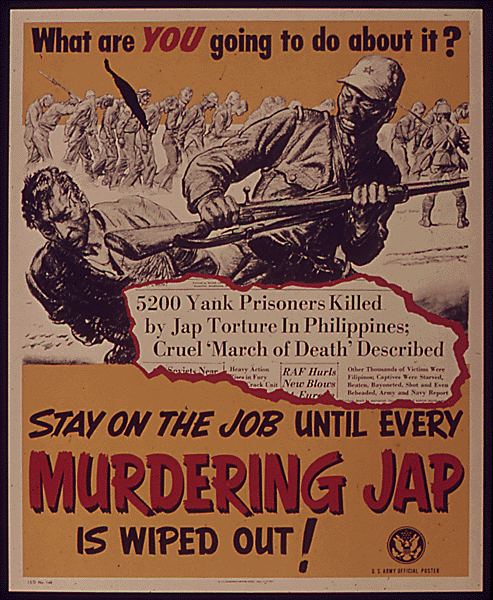
 In 1943, Paramount Pictures released this cartoon short featuring the pop culture icon, Popeye the Sailor. It was released during the time of World War II to depict the attitude of the Americans towards the Japanese at the time. The cartoon also represents Japanese in an offensive manner using caricatures drawn from offensive stereotypes. In this cartoon, Popeye is sailing his ship when he spots a Japanese battleship through his telescope. He parks his boat right next to them, and before he can act out of anger, the Japanese present him with a peace treaty. Popeye, skeptical at first, finally attempts to sign it, but the Japanese repeatedly bother and provoke him while he's not looking ultimately signifying their "backstabbing nature" and inability to keep their treaty of peace. The multiple hits while Popeye is not looking, again, depict the Japanese as a sneaky people, making references to the bombing at Pearl Harbor.
 This war propaganda cartoon was never aired and banned because of its racist portrayal of the Japanese. One noticeable depiction is that they all looked the same. All Japanese characters donned the same round pair of glasses, Japanese kimono, wooden sandals, and buck teeth speaking in what sounds like Japanese. Racism against the Japanese was very strong around this time. These stereotypes were based on actual racist stereotypes of the Japanese. At the time of this cartoon, Japanese Americans experienced a surge of racism. Some believe the internment of Japanese Americans into camps were racially motivated, not for military purposes as publicly stated. Lots of mediums of pop culture such as music, literature, and propaganda dehumanized the Japanese, calling them names like "dirty Japs" or different types of animals. Any Japanese American at the time was vulnerable to this racism.
 Having had enough of the Japanese's antics, Popeye decides to teach them a lesson but eventually finds himself battling the entire naval battleship of the Japanese. As it appears that Popeye is about to lose, he eats a can of spinach and proceeds to beat up the entire Japanese navy. As he rests, the ship begins to fall apart. He holds a sign that reads: MADE IN JAPAN which he easily crumbles into pieces implying that Japanese products are substandard or incompetent to American products. The general of the ship consumes a tank of gasoline and kills himself while Popeye watches the ship die. The cartoon ends with the Japanese flag being submersed and Popeye celebrating a victory.
This cartoon is one of many racist forms of propaganda that circulated at the time of World War II. It portrayed the Japanese in a very offensive and stereotypical manner that was reflective of the racism that was popular during the time. The Japanese are portrayed to be backstabbers, people unable to be trusted. Lots of these racist sentiments toward the Japanese were fueled by anger from the Pearl Harbor attacks, causing many citizens to act violently. A 1942 comic strip published ways to distinguish a Japanese phenotypically.

They are also portrayed to be fanatic as shown in the climactic sequence of the cartoon when the general decides to "save face" and commit suicide rather than lose. This is evident by the desperate kamikaze tactics the Japanese used during the war in which fighter pilots would crash into naval ships sacrificing their lives to kill American soldiers. The cartoon ends with the Japanese ship sinking and Popeye, the representation of America, watching their foreshadowed defeat.
Lawrence Dalusung
Monday, November 30, 2009
Wally Kaname Yonamine

Wally Kaname Yonamine is a multi-sport professional. Yonamine became the first Asian to play professional football in the United States (he played in the National Football League) and became the first American to play professional baseball in Japan after World War II. However, though he accomplished these great feats, Yonamine faced a lot of adversity, scorn, and obstacles. Because of World War II and the animosity between Americans and the Japanese that came as a result of the war, Yonamine, as a Japanese American, had to adapt to unfamiliar cultures and overcome prejudice against his ancestry in both the Japanese and American
environments/societies.
 Yonamine was born on June 24, 1925 in Maui, Hawaii on a poor sugar plantation to Japanese immigrants. After moving to Oahu and leading his high school (Farrington High School) to its first Honolulu city football championship, Yonamine got his first public acclamation as an athlete in 1944. Eventually he was signed by the San Francisco 49ers in 1947 as a running back and became the first ethnic Japanese to play football professionally. However, after being in the NFL for a few years, an injury forced him to end his football career. Thus, unable to play football, Wally Yonamine turned to baseba
 ll instead and later became the man that changed Japanese baseball forever.
While playing baseball for the San Francisco Seal’s, the manager urged him to consider playing professional baseball in Japan. In 1951, the Yomiuri Giants signed Yonamine as an outfielder, and he became the first American to play baseball in postwar Japan. He became known as the “Jackie Robinson” of Japanese baseball (Jackie Robinson was the first African American to play Major League Baseball in the states and broke the barrier of having whites only playing baseball). Applying his football skills/mentality to baseball, Yonamine quickly became one of the most dominant players in the league. He would play hard and with immense intensity by stealing bases, running aggressively, doing hard slides, and by knocking d
 own opponents. His tactics changed the way the Japanese would play baseball forever. Before Yonamine came to Japan, the Japanese had a more reserve mentality when it came to playing baseball. So when Yonamine arrived, the Japanese fans didn’t appreciate his hard-hitting tactics. They thought he was too abrasive and aggressive. The fans would hurl rocks and insults at him. However, Yonamine’s dominance proved far too great for the fans’ hatred of him to continue.
In his years as a player, Yonamine is considered to be the greatest leadoff hitter in Japanese baseball history. In his first year alone he had a batting average of .354 (anything above .300 is considered really good). In his career he won three batting championships and in 1957 he was named MVP (most valuable player). After retiring as a player, despite troubles of adapting to Japanese culture, Yonamine stayed in Japan for many years serving as a coach and manager. As a coach, he was responsible for changing how Japanese baseball was played. He taught his players the “American way” (American practices of baseball) such as hard sliding, running out bunts and grounders (hustling), and diving for balls. He taught his players how to be aggressive and assertive.
In 1994, Wally Yonamine was elected to the Japanese Hall of Fame. Even through his old age, Yonamine continued to be a role model. He made contributions to Japanese and American foreign relations. He will forever be a key figure in Asian American history. As both an American and Japanese man, Yonamine was able to make an impact in both countries/societies. In America, Yonamine was able to show his skills in football despite being Asian, and in Japan, he was able to his greatness in baseball through his American knowledge.

---
http://www.discovernikkei.org/en/interviews/profiles/26/
http://eastwindupchronicle.com/baseball-japan/wally-yonamine/
http://wallyyonamine.com/
---
Denise Lee
Forgotten Heroes: The 442nd RCT and 100th Battalion

In recent years the 442nd Regimental Combat Team and the 100th Battalion have finally received some of recognition they deserve as heroes of World War II. The 442nd was an a unit comprised completely of Asian Americans, mostly Japanese Americans from Hawaii. The unit is the most highly decorated regiment in history.
On February 1, 1943, following the successful training of the 100th Battalion, permission was granted to form what became the 442nd. In May of that year, training of the approximately 4000 troops took place at Camp Shelby in Mississippi. At first there was a lot of tension between the mainland (or kotonks for the “noise made by the coal which these "yardbirds" had had to shovel as members of housekeeping detachments at Army posts; others said it was the sound made by their heads when Island boys knocked them together”) and Hawaiian Japanese Americans (or buddhaheads that comes from “The Japanese word "buta" means pig, and "buddhahead" may be a corruption of "buta head," but it was generally thought that the term had been imported from Hawaii where it was applied to Japanese Buddhist priests who shaved their heads, and, by extension, to the Japanese residents generally”) because of various difference such as speaking barriers where Hawaiian Japanese tended to speak pidgin English while mainland Japanese would speak more traditional English. This fighting halted however after the Hawaiian boys visited one of the internment camps. Busses took the troops to visit both the Rohwer and Jerome camps. Suddenly the Hawaiian boys had a better understanding of what the mainlanders had been through and thus created a more united team. Katsugo Miho of the 522nd Field Artillery, 442nd RCT said of the trip “the reception we got from the people in camp was simply astounding. Putting up a cheerful front to us. I don’t remember any of them crying to us or g iving us a sad story. All of them were going out of their way to encourage us. When you reflect on it, it should have been the other way around. We should have been encouraging them.”
Following their training, the 442nd was was shipped off to Europe where they participated in several missions. They helped to rescue the “lost Battalion” in France, suffering over 800 casualties (including 121 fatalities) to save a mere 211 of their white counterparts. They also were the first to reach the Dachau concentration camp and help to release those who were imprisoned within the fences. The following year the 442nd returned home and was recognized by President Truman where he said “You fought not only the enemy, but you fought prejudice-and you have won.”
Truman's words may have been powerful, but they were only partially true. The fact was that following their return home, despite all of their heroic efforts, they were still discriminated against as members of the 442nd were given honors far less then what they had deserved, if given at all. Only one medal of  Honor was initially awarded to the members of the 442nd. It took until the year 2000 when 20 additional Japanese Americans were awarded the Medal of Honor, many of whom posthumously. Also in 1999, the Go For Broke National Education Center honored the Japanese Americans who served during World War II with a monument in Little Tokyo, Los Angels. “Go For Broke” refers to the 442nd's motto that comes from a pidgin phase that basically means to risk it all typically while gambling.
Also recently, Hollywood has tried to bring the story of the 442nd to a larger American audience. Plays, documentaries, television and several movies have been made to tell the stories of these brave men. A recent adaptation is titled Only the Brave (2005) and follows the stories of several different men from prior to the war, through their time of service, to ultimately their return home (for some).
The 442nd did many things that relate to the greater Asian American community. Perhaps most importantly, they stood up and fought for a country that had not been the most welcoming to them. They fought and tried to prove that Japanese and Asian Americans were in fact American and that deserved to be treated as such. Its is great to finally see that they are starting to be remembered for all that they have done.
Jerry Knaack
http://en.wikipedia.org/wiki/442nd_Infantry_Regiment_%28United_States%29
http://www.goforbroke.org/history/history_historical.asp
http://nisei.hawaii.edu/page/442
http://74.125.95.132/search?q=cache:RP3d3yhYgYQJ:www.ajawarvets.org/campaigns/campaign_01_introduction.cfm+kotonks&cd=3&hl=en&ct=clnk&gl=us&client=firefox-a
Subscribe to:
Posts (Atom)